Protein & Sports Nutrition

If you have tried shopping for the best collagen supplements, you already know the problem is not a lack of options. It is the opposite. Powders, gummies, capsules, and chews all promise better skin and happier joints, the labels read like a chemistry exam, and prices range from a few dollars to the cost of a nice dinner. It is easy to buy whatever has the best reviews and hope for the best.
As a naturopathic doctor, I would rather you choose with a plan. The most useful thing to know is that no single collagen is right for everyone, because the research behind collagen is goal specific. The amount and type studied for skin hydration are different from what has been studied for joint comfort, and both differ from what makes sense if you are trying to stay strong as you age.
This guide walks through how collagen works, how to support it from your plate, six things to check on any label, and how to match a product to what you want to achieve. The criteria apply to any brand you are comparing.
What Collagen Does in Your Body

Collagen is the most abundant protein in the body, and the easiest way to picture it is as scaffolding. It gives skin its firmness, bones their framework, and tendons, ligaments, and cartilage the strength to hold you together and let you move. Your body builds its own collagen, but production slows with age, which is part of why skin gradually thins, and joints can feel less resilient over time.1
It helps to think of your musculoskeletal frame as a system rather than a collection of parts. Collagen is the scaffold. The muscle attached to it moves and stabilizes that scaffold. And vitamin C is an essential cofactor your body needs to assemble collagen in the first place.2 Approaches that support all three tend to make more sense than focusing on one piece in isolation, and that idea shapes the product guidance later in this article.
Start With Your Plate
Before any supplement, a naturopathic approach asks whether your diet is giving your body what it needs to make collagen on its own. Three things matter most.
The first is enough total protein. Collagen is built from amino acids, especially glycine, proline, and lysine, so a diet that is light on protein leaves less raw material to work with. Collagen itself is not a complete protein, since it lacks the essential amino acid tryptophan, which means a collagen supplement should sit alongside protein-rich meals rather than replace them.3
The second is vitamin C, found in citrus, berries, kiwi, bell peppers, and broccoli, which your body relies on at a key step of collagen formation.2 The third is collagen-rich foods themselves, such as bone broth, gelatin, and fish eaten with the skin on.
Lifestyle matters as well. Ultraviolet light from the sun is one of the main drivers of collagen breakdown in the skin, so daily sun protection does a lot to preserve what you already have.2 A supplement works best on top of these basics, not in place of them.
How to Choose the Best Collagen Supplement: 6 Things to Check

These six checks work for any label you are holding, and together they cut through most of the marketing that surrounds the best collagen supplements.
1. Match the Dose to Your Goal
This is the single most useful fact in this guide, and very few product pages spell it out. There is no official recommended daily amount for collagen, but the research clusters around specific doses. For skin hydration and elasticity, studies most often use 2.5 to 5 grams of collagen peptides a day for 8 to 12 weeks.4,5 For joint comfort and mobility, studies typically use about 10 grams of hydrolyzed collagen a day, or about 40 milligrams of a specialized form called undenatured type II collagen (UC-II), usually for 3 to 6 months.6,7
A product can contain real collagen and still fall short of the amount studied for your goal, so it is worth checking the dose before anything else. Our guide to collagen dosage covers this in more depth.
2. Look for "Hydrolyzed" or "Collagen Peptides" on the Label

Both terms mean the collagen has been broken down into small fragments called peptides, which the body absorbs more readily than intact collagen.6 In practice, hydrolyzed collagen and collagen peptides are the same thing, and this is the form used in most of the skin and joint research. When people search for the best collagen peptides, this is what they are really looking for. The notable exception is UC-II, which is intentionally left undenatured and works at a much smaller dose through a different mechanism.7
At Metagenics, UC-II appears in three formulas: StayStrong+ Joint & Muscle Powder, the StayStrong+ 4-in-1 Collagen Chew, and OsteoVantiv. Each provides 40 milligrams of UC-II a day when taken as directed.
3. Know Your Collagen Types and Sources
Collagen comes in several types, and the source determines which types you get. A table makes this easier to keep straight.
Type or source | Where it is found or comes from | Commonly chosen for |
Type I | Skin, bone, tendons, ligaments6 | Skin, hair, nails, bone |
Type II | Cartilage6 | Joint comfort and mobility7 |
Type III | Skin and blood vessels, usually alongside type I6 | Skin and structural support |
Bovine (cow) | Supplies types I and III6 | Widely studied and usually affordable |
Marine (fish) | Mostly type I6 | Skin; avoid with a fish allergy |
Chicken | A source of type II6 | Joint and cartilage support |
One label to read carefully is "vegan collagen." Collagen only comes from animals, so these products contain no collagen. Instead, they supply nutrients your body uses to make its own. That is a legitimate approach, just a different one.
Collagenics is an example: it contains no collagen and instead combines vitamin C, zinc, copper, and manganese with the amino acids proline and lysine and horsetail, a natural source of silica, to support healthy connective tissue and collagen.

Collagenics®
Supports healthy connective tissue and collagen*
Each ingredient has a job: vitamin C is needed by the enzymes that stabilize newly made collagen,2 copper helps cross-link collagen fibers so they hold together,8 and proline is one of the main amino acids collagen is built from.3 Zinc, manganese, iron, magnesium, vitamin B6, and pantothenic acid round out the formula. Our overview of collagen types goes further into the differences.
4. Choose a Form That Delivers a Real Dose
Form is not just a matter of taste. It decides whether you can realistically reach a studied dose. A scoop of powder typically delivers 5 to 20 grams, which comfortably covers most goals, and this is why the best collagen powder for most people is simply one that provides a studied dose they will take every day. Capsules often require several pills to reach the same amount. Gummies and chews are convenient, but each piece weighs only a few grams in total, so they usually contain far less collagen than a scoop of powder. None of these formats are wrong. It just helps to know what you are getting in each delivery system.
5. Check Testing and Label Transparency
Supplements are not reviewed by the FDA before they are sold the way medications are, so independent testing is the best way to know if the label is accurate. Ingredient and formulation testing confirms the ingredient is what it claims to be, that the ingredient dose matches the label, and screens for contaminants such as heavy metals. Learn more about Metagenics testing and processes.
6. Know Why the Extra Ingredients Are There
Many collagen products add additional ingredients, and a few are worth having. Vitamin C is the clearest example, since your body cannot assemble collagen without it.2 Others support the muscles, nerves, and energy systems that work alongside your connective tissue. Here is what the supporting ingredients in the Metagenics StayStrong+ formulas, OsteoVantiv, and Collagenics formulas do, and where you will find each one.
Ingredient | Why it is included | Where you will find it |
Vitamin C | Needed to build and stabilize collagen2 | StayStrong+ Joint & Muscle Powder, StayStrong+ 4-in-1 Collagen Chew, Collagenics |
Creatine monohydrate | Supports strength and lean muscle alongside resistance training9 and helps supply energy to brain cells10 | StayStrong+ Joint & Muscle Powder, StayStrong+ Brain & Body Powder |
Vitamin D | Supports muscle function11 and normal immune function12 | StayStrong+ Joint & Muscle Powder, StayStrong+ Brain & Body Powder |
Magnesium | Supports muscle and nerve function and energy production,13 and helps the body activate vitamin D14 | StayStrong+ Joint & Muscle Powder, OsteoVantiv, Collagenics |
Tetrahydro iso-alpha acids (THIAA) from hops | Included to support joint relief and to comfort sore joints after exercise in healthy people; human research on this ingredient is still limited | OsteoVantiv |
Copper | Helps cross-link collagen fibers so they hold together8 | Collagenics |
Additions like these earn their place when they match your goal and appear in meaningful amounts. A long list of ingredients in tiny amounts deserves a closer look.
Choosing Your Collagen by Goal
With the framework in place, here is how it applies to the goals people ask about most, since the best collagen supplements for one goal are not always the best for another. This table summarizes what research has used for each goal, followed by the detail behind it.
Goal | Amount studied | Typical timeline | Option to consider |
Skin hydration and elasticity | 2.5 to 5 g collagen peptides daily4,5 | 8 to 12 weeks4 | StayStrong+ Brain & Body Powder |
Joint comfort and mobility | About 10 g hydrolyzed collagen or 40 mg UC-II daily6,7 | 3 to 6 months6 | StayStrong+ Joint & Muscle Powder, StayStrong+ 4-in-1 Collagen Chew, or OsteoVantiv |
Strength as you age | Collagen peptides with resistance training15,16 | About 12 weeks or more15 | StayStrong+ Joint & Muscle Powder or StayStrong+ Brain & Body Powder |
Everyday whole-body support | 40 mg UC-II daily from two chews,7 plus smaller amounts of three collagen peptides | Ongoing, as part of a daily routine | StayStrong+ 4-in-1 Collagen Chew |
For Skin, Hair, and Nails

Skin is where the evidence is strongest. Reviews of randomized trials suggest collagen peptides can support skin hydration and elasticity, usually after 8 to 12 weeks of daily use.4,5 There is also a smaller body of research on nails, including a study in which collagen peptides were associated with faster nail growth and fewer brittle nails.17 Evidence for hair is more limited, so it is fair to keep expectations modest there. A more expensive source, such as marine collagen, is not in itself a guarantee of better skin results.
For this goal, StayStrong+ Brain & Body is a good fit. Each scoop provides 2.5 grams of VERISOL hydrolyzed collagen peptides, the specific peptide and dose shown in a placebo-controlled study to support skin elasticity.18 The rest of the formula is there for a reason, too. Its 5 grams of creatine monohydrate supports lean muscle and strength alongside resistance training9 and helps supply energy to brain cells,10 while 2,000 IU of vitamin D3 supports muscle function11 and normal immune function.12 A 100 milligram blend of 29 fruits, vegetables, and herbs rounds it out.

StayStrong+ Brain and Body Collagen and Creatine Powder
Collagen + creatine powder for strength, energy, and cognitive support*
Our article on collagen peptides for hair, skin, nails, and joints has more on what the research shows.
For Joint Comfort and Mobility

For joints, research points down two paths. One uses larger amounts of hydrolyzed collagen, around 10 grams a day.6,19 The other uses UC-II at about 40 milligrams a day, which in a study of healthy adults supported joint comfort and range of motion during exercise.7 Both have been studied over a period of months, not days.
This is where the systems view becomes practical. StayStrong+ Joint & Muscle combines 40 milligrams of UC-II, the daily amount studied for joint comfort,7 for the cartilage side with 5 grams of creatine monohydrate for the muscles that support and move the joint.9

StayStrong+ Joint and Muscle Powder
Collagen, creatine, and magnesium powder for strength and joint health.*
Each supporting ingredient has a role. Its 100 milligrams of magnesium, as an amino acid chelate and bisglycinate, supports muscle and nerve function and energy production13 and helps the body activate vitamin D.14 Vitamin D itself supports muscle function,11 and 100 milligrams of vitamin C supplies the cofactor your body needs to build collagen.2 You can read more about how this form works in our UC-II collagen guide, or browse the joint and bone collection.
If you would rather take a tablet than mix a powder, OsteoVantiv is another way to get UC-II. Taken as directed, one tablet twice daily with food, it provides 40 milligrams of UC-II, the amount studied for joint comfort,7 along with 600 milligrams of a proprietary, enriched form of tetrahydro iso-alpha acids (THIAA) from hops and 75 milligrams of magnesium. THIAA is included to support joint relief and to help comfort sore joints and promote joint flexibility after exercise.

OsteoVantiv®
Provides joint relief & supports joint flexibility.*
Human research on THIAA is still limited, so think of it as a partner to UC-II rather than the main ingredient. Magnesium supports normal muscle and nerve function.13 OsteoVantiv contains no creatine or collagen peptides, so it suits someone focused on joint comfort alone, and it is not intended for use during pregnancy or while nursing.
For Strength and Lean Muscle as You Age

This is where honesty matters most. Collagen does not build muscle on its own. Because it is not a complete protein, it does not stimulate muscle protein synthesis the way a complete protein does.20 What the research does show is that when collagen peptides are paired with resistance training, results improve beyond training alone. In older men, the combination led to greater gains in lean mass and strength, and in middle-aged men it led to greater gains in lean mass, possibly by supporting the connective tissue that transfers muscular force.15,16
That is the reasoning behind pairing collagen with creatine for healthy aging. Creatine is one of the most researched supplements for supporting strength and muscle alongside resistance training in older adults.9 Both StayStrong+ powders pair collagen with a full 5 gram serving of creatine, and our articles on creatine and collagen together and creatine for women explain the rationale in more detail.
For Every Day, Whole-Body Support

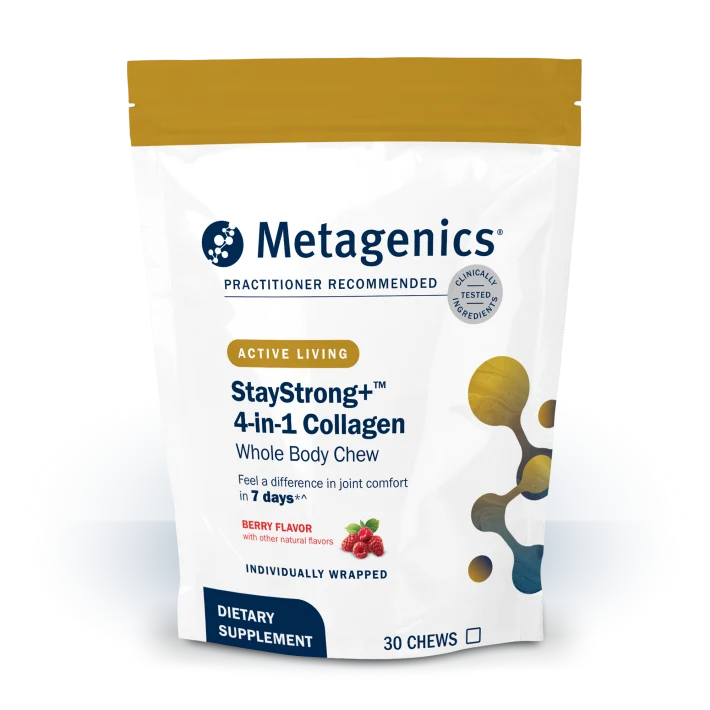
If your goal is general maintenance rather than one specific outcome, a formula with several collagen types can cover more ground. The StayStrong+ 4-in-1 Collagen Whole Body Chew combines four forms of collagen, each chosen for a different tissue. VERISOL is the peptide studied for skin elasticity,18 specific collagen peptides like FORTIGEL have been researched for activity-related knee comfort in athletes,21 TENDOFORTE has been studied alongside resistance training for its effects on tendons,22 and UC-II targets cartilage.7

StayStrong+ 4-in-1 Collagen Whole Body Chew
Four types of collagen in one chew, supporting joints, movement, and skin.*
Taken as directed, one chew twice daily, it provides 40 milligrams of UC-II, the amount used in joint research, along with 250 milligrams each of VERISOL, FORTIGEL, and TENDOFORTE and 50 milligrams of vitamin C.
Those peptide amounts are smaller than the doses used in the skin, joint, and tendon studies, so the chew suits everyday support and anyone who would rather not mix a powder. You can see the full range on the StayStrong+ collagen page.
DID YOU KNOW?
Your body cannot build collagen without vitamin C, which is an essential cofactor in the process.2 If your diet runs low in fruits and vegetables, a vitamin C supplement such as Ultra Potent-C, which provides about 1,000 milligrams per serving, can help fill the gap.
What to Expect, and When
Collagen works slowly, and knowing the timeline helps you judge it fairly. For skin, most studies measured changes after 8 to 12 weeks of daily use, not after the first tub.4 For joints, studies of hydrolyzed collagen and UC-II have generally run for three months or longer.6,7 Strength outcomes come from studies that paired collagen with regular resistance training for about three months.15 In practice, that means taking your collagen every day, combining it with the basics of protein, vitamin C, and movement, and giving it at least two to three months before deciding whether it is working for you.
Are Collagen Supplements Safe? Side Effects and Who Should Check First
For most healthy adults, collagen supplements are well tolerated, and reviews of the research report few side effects, usually mild digestive fullness.23 A few situations still call for a conversation with your healthcare provider first:
Fish or shellfish allergy: avoid marine collagen and check the source on the label.
Pregnancy or breastfeeding: safety data is limited, so ask your clinician first.
Kidney disease or a protein-restricted diet: check before adding any protein supplement, and especially before formulas that also contain creatine.24
Medications: interaction data is limited, so bring the label to your provider.
Dietary or religious restrictions: confirm the source animal, since collagen comes from cows, pigs, fish, or chicken.
A NOTE BEFORE YOU START
This article is educational and is not medical advice. Supplements work best on top of the basics, not instead of them. If you are pregnant, nursing, managing a health condition, or taking medication, talk with your healthcare provider before starting a new supplement.
The Bottom Line
The best collagen supplement is not the one with the loudest claims. It is the one that matches your goal, delivers a studied dose in a form you will take consistently, and comes from a brand willing to prove its quality. Decide what you want collagen to do, use the six checks to compare your options fairly, keep supporting your body's own collagen with protein, vitamin C, and sun protection, and give your choice a consistent two to three months before you judge it.
Frequently Asked Questions On Collagen Supplements
There is no single best option, because the right choice depends on your goal. For skin, look for 2.5 to 5 grams of hydrolyzed collagen peptides a day. For joints, look for about 10 grams of hydrolyzed collagen or about 40 milligrams of UC-II, which you will find in StayStrong+ Joint & Muscle Powder, the StayStrong+ 4-in-1 Collagen Chew, and OsteoVantiv. For staying strong as you age, a formula that pairs collagen with creatine, combined with resistance training, makes sense. Whatever your goal, a third-party tested product with a clear dose on the label is a good place to start.
It depends on your goals and your diet. If you want to support skin hydration, joint comfort, or strength as you age, and you are willing to take it daily for a couple of months, collagen is a reasonable and well-tolerated option. If you already eat plenty of protein and have no particular goal in mind, you may not need one. Your healthcare provider can help you decide.
Consistency matters more than timing. Collagen can be taken at any time of day, with or without food, so the best time is whenever you will remember it every day. Many people stir it into morning coffee or a smoothie, and others prefer it after a workout or in the evening.
Use the six checks in this guide: match the dose to your goal, look for hydrolyzed collagen or collagen peptides, know your collagen types and sources, choose a form that delivers a real dose, check testing and label transparency, and know why any extra ingredients are there. Together, they let you evaluate any product on the shelf.
References
Varani J, Dame MK, Rittie L, et al. Decreased collagen production in chronologically aged skin: roles of age-dependent alteration in fibroblast function and defective mechanical stimulation. Am J Pathol. 2006;168(6):1861-1868. https://doi.org/10.2353/ajpath.2006.051302
Pullar JM, Carr AC, Vissers MCM. The roles of vitamin C in skin health. Nutrients. 2017;9(8):866. https://doi.org/10.3390/nu9080866
Paul C, Leser S, Oesser S. Significant amounts of functional collagen peptides can be incorporated in the diet while maintaining indispensable amino acid balance. Nutrients. 2019;11(5):1079. https://doi.org/10.3390/nu11051079
Myung SK, Park Y. Effects of collagen supplements on skin aging: a systematic review and meta-analysis of randomized controlled trials. Am J Med. 2025;138(9):1264-1277. https://doi.org/10.1016/j.amjmed.2025.04.034
Pu SY, Huang YL, Pu CM, et al. Effects of oral collagen for skin anti-aging: a systematic review and meta-analysis. Nutrients. 2023;15(9):2080. https://doi.org/10.3390/nu15092080
Martinez-Puig D, Moller I, Fernandez C, Chetrit C. Collagen supplementation for joint health: the link between composition and scientific knowledge. Nutrients. 2023;15(6):1332. https://doi.org/10.3390/nu15061332
Lugo JP, Saiyed ZM, Lau FC, et al. Undenatured type II collagen (UC-II) for joint support: a randomized, double-blind, placebo-controlled study in healthy volunteers. J Int Soc Sports Nutr. 2013;10(1):48. https://doi.org/10.1186/1550-2783-10-48
Rucker RB, Kosonen T, Clegg MS, et al. Copper, lysyl oxidase, and extracellular matrix protein cross-linking. Am J Clin Nutr. 1998;67(5 suppl):996S-1002S. https://doi.org/10.1093/ajcn/67.5.996S
Candow DG, Forbes SC, Chilibeck PD, Cornish SM, Antonio J, Kreider RB. Effectiveness of creatine supplementation on aging muscle and bone: focus on falls prevention and inflammation. J Clin Med. 2019;8(4):488. https://doi.org/10.3390/jcm8040488
Roschel H, Gualano B, Ostojic SM, Rawson ES. Creatine supplementation and brain health. Nutrients. 2021;13(2):586. https://doi.org/10.3390/nu13020586
Beaudart C, Buckinx F, Rabenda V, et al. The effects of vitamin D on skeletal muscle strength, muscle mass, and muscle power: a systematic review and meta-analysis of randomized controlled trials. J Clin Endocrinol Metab. 2014;99(11):4336-4345. https://doi.org/10.1210/jc.2014-1742
Maggini S, Pierre A, Calder PC. Immune function and micronutrient requirements change over the life course. Nutrients. 2018;10(10):1531. https://doi.org/10.3390/nu10101531
de Baaij JH, Hoenderop JG, Bindels RJ. Magnesium in man: implications for health and disease. Physiol Rev. 2015;95(1):1-46. https://doi.org/10.1152/physrev.00012.2014
Uwitonze AM, Razzaque MS. Role of magnesium in vitamin D activation and function. J Am Osteopath Assoc. 2018;118(3):181-189. https://doi.org/10.7556/jaoa.2018.037
Zdzieblik D, Oesser S, Baumstark MW, Gollhofer A, Konig D. Collagen peptide supplementation in combination with resistance training improves body composition and increases muscle strength in elderly sarcopenic men: a randomised controlled trial. Br J Nutr. 2015;114(8):1237-1245. https://doi.org/10.1017/S0007114515002810
Kirmse M, Oertzen-Hagemann V, de Marees M, Bloch W, Platen P. Impact of collagen peptide supplementation in combination with resistance training on body composition and muscle strength in middle-aged men: a randomized controlled trial. Int J Environ Res Public Health. 2019;16(18):3415. https://doi.org/10.3390/ijerph16183415
Hexsel D, Zague V, Schunck M, Siega C, Camozzato FO, Oesser S. Oral supplementation with specific bioactive collagen peptides improves nail growth and reduces symptoms of brittle nails. J Cosmet Dermatol. 2017;16(4):520-526. https://doi.org/10.1111/jocd.12393
Proksch E, Segger D, Degwert J, Schunck M, Zague V, Oesser S. Oral supplementation of specific collagen peptides has beneficial effects on human skin physiology: a double-blind, placebo-controlled study. Skin Pharmacol Physiol. 2014;27(1):47-55. https://doi.org/10.1159/000351376
Khatri M, Naughton RJ, Clifford T, Harper LD, Corr L. The effects of collagen peptide supplementation on body composition, collagen synthesis, and recovery from joint injury and exercise: a systematic review. Amino Acids. 2021;53(10):1493-1506. https://doi.org/10.1007/s00726-021-03072-x
Oikawa SY, Kamal MJ, Webb EK, McGlory C, Baker SK, Phillips SM. The addition of collagen peptides to a carbohydrate-protein supplement does not alter acute post-exercise muscle protein synthesis. Nutrients. 2020;12(7):1951. https://doi.org/10.3390/nu12071951
Zdzieblik D, Oesser S, Gollhofer A, Konig D. Improvement of activity-related knee joint discomfort following supplementation of specific collagen peptides. Appl Physiol Nutr Metab. 2017;42(6):588-595. https://doi.org/10.1139/apnm-2016-0390
Jerger S, Centner C, Lauber B, et al. Effects of specific collagen peptide supplementation combined with resistance training on Achilles tendon properties. Scand J Med Sci Sports. 2022;32(7):1131-1141. https://doi.org/10.1111/sms.14164
Choi FD, Sung CT, Juhasz ML, Mesinkowska NA. Oral collagen supplementation: a systematic review of dermatological applications. J Drugs Dermatol. 2019;18(1):9-16. https://jddonline.com/articles/oral-collagen-supplementation-a-systematic-review-of-dermatological-applications-S1545961619P0009X/
Kreider RB, Kalman DS, Antonio J, et al. International Society of Sports Nutrition position stand: safety and efficacy of creatine supplementation in exercise, sport, and medicine. J Int Soc Sports Nutr. 2017;14:18. https://doi.org/10.1186/s12970-017-0173-z

About the Author
Dr. Malisa M. Carullo, ND, MSc
Naturopathic Doctor
Dr. Carullo serves as Senior Manager of Medical Information and Safety at Metagenics, where she supports clinical education, product safety, and evidence-based practitioner guidance across North America.
She holds a Doctorate in Naturopathic Medicine and a Master of Science in Biology, with a focus on chronic disease care, healthy aging, and evidence-based approaches to long-term wellness. Dr. Carullo is dedicated to empowering both practitioners and patients through clear, research-informed education that bridges science and everyday health decisions.
Best Collagen Supplements
StayStrong+ Brain and Body Collagen and Creatine Powder
Collagen + creatine powder for strength, energy, and cognitive support*
4.6StayStrong+ 4-in-1 Collagen Whole Body Chew
Four types of collagen in one chew, supporting joints, movement, and skin.*
4.3StayStrong+ Joint and Muscle Powder
Collagen, creatine, and magnesium powder for strength and joint health.*
4.3OsteoVantiv®
Provides joint relief & supports joint flexibility.*
5.0Collagenics®
Supports healthy connective tissue and collagen*
5.0