Protein & Sports Nutrition

Creatine and collagen together have each been building strong, separate cases in the health and wellness space. Creatine for muscle energy, strength, and potential cognitive support. Collagen for joints, tendons, skin, and structural recovery.
The more interesting question is what happens when you take them together.
These two ingredients work on different biological systems. Creatine operates inside your muscle cells, regenerating the energy your body runs on during high-intensity effort. Collagen works in the connective tissue surrounding those muscles, reinforcing the joints, tendons, and ligaments that support every movement you make.
One powers the engine while the other holds the structure together. For adults building a supplement stack around long-term performance and recovery, this combination is worth looking into.
This article covers what each nutrient does, why they complement each other, and how to take them together.
What Does Creatine Do for Your Body?
Creatine is a compound your body produces naturally, found mostly in skeletal muscle and, to a lesser extent, in the brain. We get small amounts from food, particularly red meat and fish, but supplements provide a more concentrated and consistent daily amount to support performance.
That's where supplementation comes in.
At its most basic, creatine acts as a rapid energy reserve. During high-intensity exercise, your body burns through ATP (adenosine triphosphate), the molecule that powers muscle contraction. Creatine helps regenerate ATP quickly, allowing you to sustain harder effort for longer. Over time, that may help support greater strength, power output, and lean muscle mass.1
The benefits of creatine extend beyond physical performance. Research suggests it may also support aspects of cognitive function, including memory, mental processing speed, and focus,2 especially during periods of fatigue or disrupted sleep. Your brain consumes a significant portion of your body's daily energy, and creatine helps keep that supply steady.
It also plays a meaningful role as you age. Sarcopenia—the gradual, age-related loss of muscle mass, strength, and function—is something creatine may help support, with benefits for physical function in older adults,3 along with emerging research related to bone density.
For women, who tend to have lower creatine stores and face accelerated muscle loss through perimenopause and menopause, supplementation may help preserve lean muscle and exercise capacity4 across life stages.
What Does Collagen Do for Your Body?
Collagen is the most abundant protein in the human body, acting as the structural framework for your connective tissue and providing the strength and integrity that holds everything together. It shows up throughout the body in different forms:
Type I collagen supports skin, tendons, and bones
Type II collagen is found almost exclusively in joint cartilage, the cushioning tissue that absorbs impact and keeps bones moving smoothly
Type III collagen supports blood vessels and connective tissue
In its natural state, collagen is a large, tightly wound protein that is broken down during digestion into smaller peptides and amino acids that the body can absorb.
Hydrolyzed collagen, also called collagen peptides, has already been broken down into shorter chains of amino acids through an enzymatic process. Because these fragments are significantly smaller, they're easily digested and rapidly absorbed5 into the bloodstream, where they can be used by the body.
Once absorbed, collagen peptides supply the raw materials your body uses to support the maintenance of joints, tendons, ligaments, skin, and bones over time.
The Difference Between Creatine and Collagen
Creatine and collagen are often grouped together as performance supplements, but they work through different mechanisms and support different functions.
Creatine vs. Collagen: Two Different Jobs
Creatine | Collagen | |
Where it works | Inside your cells | Outside your cells |
What it does | Energy production | Structural support |
Target tissue | Muscle and brain | Joints, tendons, ligaments, skin, bone |
Made from | 3 amino acids | 19 amino acids |
Best for | Power, strength, cognitive function | Support connective tissue structure and recovery |
The simplest way to think about it is creatine powers the engine while collagen maintains the frame.
In practice, that distinction shows up across years of activity. When your strength holds up decade over decade, or your joints stay comfortable under load, that's what this combination is designed to support.
Can You Take Creatine and Collagen Together?
Yes, you can take creatine and collagen together, and many people do as part of a broader wellness routine.
As we've discussed, creatine and collagen support different aspects of health. Creatine is best known for supporting muscle performance, strength, and recovery, while collagen has been studied for its role in supporting connective tissues, joints, and overall musculoskeletal health.
While researchers haven't extensively studied the two nutrients together, there's a substantial body of research supporting each one individually. A pooled analysis of 61 clinical trials found that creatine combined with resistance training produced significant increases in fat-free mass of approximately 1 to 2 kilograms.6 Separately, a randomized controlled trial found that participants taking collagen peptides during a 12-week resistance training program experienced greater gains in fat-free mass and muscle strength than those taking a placebo.7
Together, these findings suggest that creatine and collagen may offer complementary support for individuals focused on strength, recovery, mobility, and healthy aging.
What makes the combination particularly useful is how the two nutrients may complement each other. Creatine has been studied for effects on intramuscular IGF-1, a growth factor that signals connective tissue to remodel and repair during resistance training, while collagen provides amino acids that support connective tissue structure.
If you're already thinking about supplements to consider for your workout routine, creatine and collagen are two that work particularly well together.
Whether you start with collagen and creatine separately or in a combined formula, the daily habit is what drives results.
Creatine and Collagen Benefits: What Happens When You Stack Them

Joint, Tendon & Ligament Support
The longer you've been active, the more your joints may feel the accumulated demands of training. Collagen can help support this. Some research suggests that collagen supplementation may influence tendon properties such as, tendon thickness and structural stiffness,8 helping connective tissue keep pace with what your training asks of it.
With consistent use, collagen helps support:
Joint stability and comfort during regular activity
Tendon resilience over time
Connective tissue integrity as training demands accumulate
Stronger Muscles, Supported Structure
Creatine builds your muscle's capacity to produce more energy and complete more work each session. Over time, that accumulates into meaningful gains in strength and lean muscle mass.
Collagen supports what happens around those gains. As your muscles grow and adapt, the connective tissue surrounding them has to keep pace. Research shows that collagen peptides combined with resistance training7 produced greater improvements in both muscle strength and fat-free mass compared to training alone, making them a natural fit within any protein and sports nutrition routine.
Recovery That Supports Consistency
For adults who train regularly, the ability to show up consistently matters as much as the session itself. In the days following a workout:
Creatine may help replenish the cellular energy your muscles burned through
Collagen provides amino acids that support connective tissue9 structure as it adapts to increased activity
Together, they may help you maintain the consistency that long-term physical health depends on
You can also pair creatine and collagen with protein and magnesium to further support muscle repair and natural muscle relaxation as part of a complete daily recovery routine.
For adults who train consistently and invest in their physical health over the long term, creatine and collagen together may be one of the most practical healthy aging stacks available.*
How to Take Creatine and Collagen Together
Both creatine and collagen are typically well-tolerated, easy to work into an existing routine, and don't interfere with each other.

How Much Creatine and Collagen Should You Take?
The effective doses for both creatine and collagen are well established. Here's where to start:
Creatine: 3 to 5 grams of creatine monohydrate daily1 is the well-established maintenance dose.
Collagen: the right dose depends on what you're trying to support. Skin, hair, and nail health responds to as little as 2.5 grams of VERISOL hydrolyzed collagen peptides daily. Joint cartilage support requires 40 mg of UC-II undenatured collagen, a different form of collagen that is thought to interact with the immune system.
What to Look for on a Creatine and Collagen Supplement Label
Not all creatine and collagen supplements are created equal, and the label tells you most of what you need to know before you buy. For creatine, look for:
Creatine monohydrate listed as the form. It has the strongest and most extensive human research behind it.
3 to 5 grams per day, the dose used in clinical research
Avoid blends that don’t tell you exactly how much creatine is in each serving

For collagen, look for:
The collagen type listed clearly. Hydrolyzed collagen peptides support skin, hair, nails, and muscle. UC-II undenatured collagen supports joint cartilage.
Branded collagen ingredients like VERISOL for skin-focused support or UC-II for joint cartilage health signal clinically studied forms delivered at validated doses.
A dose that matches your goal. Hydrolyzed peptides are effective from 2.5 to 15 grams depending on the target tissue. UC-II requires 40 mg specifically
When evaluating collagen peptides and creatine on a supplement label, look for the collagen type and dose listed separately
Across both nutrients, look for:
Third-party testing verification, which confirms that what's on the label is actually in the product and at the stated dose
Individual ingredient amounts disclosed clearly
When to Take Them
Consistency matters more than timing. Both nutrients work by building up in your system over time. And both work well taken pre-workout or post-workout. The most effective approach is simply taking them at the same time each day, whenever that fits naturally into your routine.
Pairing them with a meal tends to work well for most people.
Creatine and collagen can be taken together, but the best routine depends on the form you’re using.
Creatine monohydrate is typically taken once daily, every day, including rest days. A standard dose is 3 to 5 grams. Timing matters less than consistency, so the focus should be on getting it in daily rather than trying to time it perfectly around a workout.
Hydrolyzed collagen peptides are also taken once daily, with the dose depending on your goal.
If you’re using collagen for connective tissue support around training, there is some support for taking it about an hour before exercise, ideally with vitamin C. Otherwise, it can be taken at any time that fits your routine.
UC-II is different. It is used at a much smaller dose, typically 40 mg once daily. Timing is flexible here as well, so the most important factor is taking it consistently.
For most people, a simple once-daily routine is enough. A practical approach is to take everything at the same time each day, such as with breakfast or a post-workout shake, to make it easy to stay consistent.
Ready-to-Stack Options That Do the Work for You
If you're already thinking about supplements to consider for your workout routine, Metagenics has built the combination into purpose-formulated options within the StayStrong+ line.

StayStrong+ Brain and Body delivers 5 grams of micronized creatine monohydrate alongside 2.5 grams of VERISOL hydrolyzed collagen peptides per serving, formulated to support muscle energy, cognitive performance, skin hydration, and elasticity in one daily scoop.

StayStrong+ Brain and Body Collagen and Creatine Powder
Collagen + creatine powder for strength, energy, and cognitive support*
For broader joint and muscle support, StayStrong+ Joint and Muscle Collagen Creatine Powder pairs creatine with UC-II collagen, magnesium, Vitamin C, and Vitamin D in one daily scoop.

StayStrong+ Joint and Muscle Powder
Collagen, creatine, and magnesium powder for strength and joint health.*
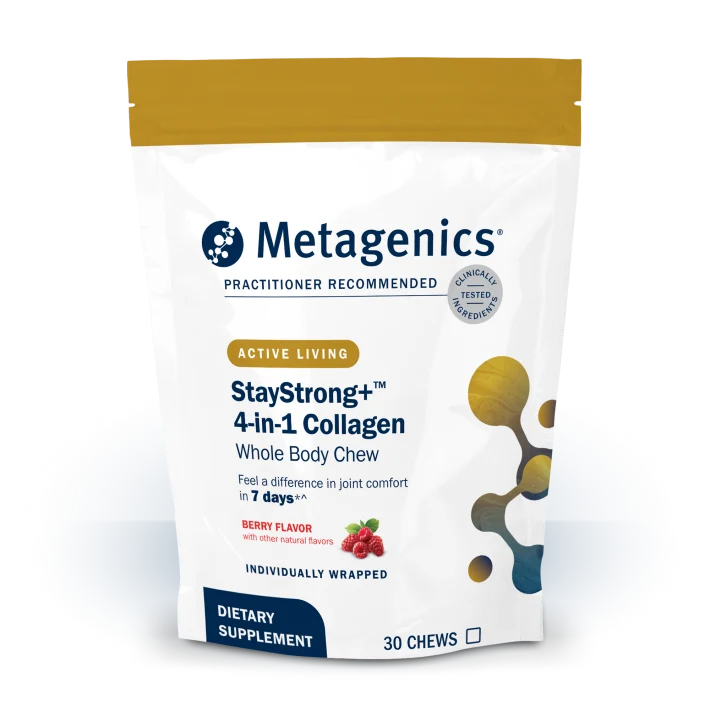
For those who prefer a format they can take anywhere, StayStrong+ 4-in-1 Collagen Chews deliver four clinically studied collagen types, including UC-II, with no mixing required.

StayStrong+ 4-in-1 Collagen Whole Body Chew
Four types of collagen in one chew, supporting joints, movement, and skin.*
The Long-Term Case for Creatine and Collagen Together
Staying strong over time depends on more than muscle. It also depends on the joints, tendons, and connective tissue that support how your body moves and adapts. Creatine and collagen support different parts of that system, helping you build strength while also supporting the structures that make that strength sustainable.
Creatine and collagen aren’t quick fixes. Both are meant to be taken consistently over time, with steady daily use that supports long-term performance.
If you're ready to build a routine around both, StayStrong+ Joint and Muscle Collagen Creatine Powder and StayStrong+ Brain and Body are practitioner-formulated options designed to take the guesswork out of getting both nutrients right.*
References
Wax B, Kerksick CM, Jagim AR, Mayo JJ, Lyons BC, Kreider RB. Creatine for exercise and sports performance, with recovery considerations for healthy populations. Nutrients. 2021;13(6):1915.
Candow DG, Forbes SC, Ostojic SM, et al. "Heads up" for creatine supplementation and its potential applications for brain health and function. Sports Med. 2023;53(Suppl 1):49-65.
Candow DG, Forbes SC, Chilibeck PD, Cornish SM, Antonio J, Kreider RB. Effectiveness of creatine supplementation on aging muscle and bone: focus on falls prevention and inflammation. J Clin Med. 2019;8(4):488.
Dos Santos EEP, de Araújo RC, Candow DG, et al. Efficacy of creatine supplementation combined with resistance training on muscle strength and muscle mass in older females: a systematic review and meta-analysis. Nutrients. 2021;13(11):3757.
Czajka A, Kania EM, Genovese L, et al. Daily oral supplementation with collagen peptides combined with vitamins and other bioactive compounds improves skin elasticity and has a beneficial effect on joint and general wellbeing. Nutr Res. 2018;57:97-108.
Ashtary-Larky D, Mohammadi S, Hajizadeh L, et al. Creatine supplementation and resistance training: a comparison between novice and experienced lifters — a systematic review and dose-response meta-analysis. J Int Soc Sports Nutr. 2025;22(Suppl 1):2586523.
Zdzieblik D, Oesser S, Baumstark MW, Gollhofer A, König D. Collagen peptide supplementation in combination with resistance training improves body composition and increases muscle strength in elderly sarcopenic men: a randomised controlled trial. Br J Nutr. 2015;114(8):1237-1245.
Nulty CD, Phelan K, Erskine RM. Hydrolysed collagen supplementation enhances patellar tendon adaptations to 12 weeks' resistance training in middle-aged men. Eur J Sport Sci. 2025;25(4):e12281.
Shaw G, Lee-Barthel A, Ross MLR, Wang B, Baar K. Vitamin C-enriched gelatin supplementation before intermittent activity augments collagen synthesis. Am J Clin Nutr. 2017;105(1):136-143.
Burke DG, Candow DG, Chilibeck PD, et al. Effect of creatine supplementation and resistance-exercise training on muscle insulin-like growth factor in young adults. Int J Sport Nutr Exerc Metab. 2008;18(4):389-398.

About the Author
Metagenics Medical Education Team
Healthcare Practitioners & Scientists
Our team of licensed health practitioners, clinical scientists, and nutrition experts creates and reviews content to ensure every article reflects current research, clinical expertise, and our commitment to scientific rigor—so you can trust what you read.
Browse Collagen Supplements
Collagen, creatine, and magnesium powder for strength and joint health.*
StayStrong+ Joint and Muscle Powder
4.3Collagen + creatine powder for strength, energy, and cognitive support*
StayStrong+ Brain and Body Collagen and Creatine Powder
4.6Four types of collagen in one chew, supporting joints, movement, and skin.*
StayStrong+ 4-in-1 Collagen Whole Body Chew
4.3