Protein & Sports Nutrition

For decades, creatine wore a very specific uniform. A tank top, a gym membership, and almost always a male body. The research followed the same pattern, studying men and quietly assuming the findings transferred. They mostly do, but that assumption skipped over something important, which is that women have their own physiology and their own reasons to care about this molecule. Creatine for women is not a marketing spin on a men's supplement. It is a genuinely different and, in some ways, more compelling conversation.
Here is the fact that reframes everything. Women store far less creatine in their bodies than men do and tend to eat less of it from food. That single difference is why the benefits of creatine reach well beyond the weight room, into energy, recovery, mood, bone, and healthy aging. This guide walks through what creatine actually does, how those benefits shift across the different stages of a woman's life, exactly how much to take, and how to fit it into a routine you will keep.
Along the way, we will settle the question that stops many women before they start. No, it will not make you bulky.
What Is Creatine and What Does It Do for Women?

Creatine is a compound your body already makes and stores, mostly in your muscles, with a meaningful amount in your brain. You also get it from food, primarily red meat and seafood. It is not a stimulant, a steroid, or anything exotic. It is a natural part of how your cells produce energy.
To understand why it matters, picture how your cells power quick, demanding tasks. The fuel your cells run on is a molecule called ATP, short for adenosine triphosphate. Think of ATP as a rechargeable battery. During a hard effort, whether that is a heavy set, a sprint up the stairs, or an intense stretch of focus, your cells burn through ATP fast. Creatine, stored as phosphocreatine, is the fast charger that snaps those batteries back to full so you can keep going.1 More available creatine means a quicker recharge and more energy on demand.
Now the female specific part. Research shows women carry substantially lower natural creatine stores than men and often take in less through diet, which means the tank many women are working with is running low to begin with.1 That is exactly why supplementing can be so worthwhile: you are not overfilling an already full tank, you are topping up one that tends to sit lower. It reframes what creatine supplements for women are really for, less a performance hack and more a way to restore something the female body is often short on.
This is doubly true if you eat little or no meat. Because the creatine in food comes mostly from red meat and seafood, women who follow vegetarian or plant forward diets tend to have lower stores still, and research suggests they may see especially meaningful gains from supplementation.2 If your plate skews plant based, creatine may be one of the more worthwhile additions to your routine.
DID YOU KNOW?
Women store roughly 70 to 80 % less creatine in their bodies than men, and typically eat less of it too.1 Because so much early creatine research focused on men, this female difference was overlooked for years, which is part of why the benefits of creatine are only now getting the attention they deserve.
The Benefits of Creatine for Women
So what does creatine do for women, specifically? The evidence points to a handful of benefits that stack together, from the obvious strength gains to some you might not expect.
Strength, Power, and Exercise Performance
This is creatine's best documented benefit, and it holds up well in women. By keeping those cellular batteries charged, creatine supports the short, intense efforts that build strength, whether you are lifting, sprinting, or pushing through the last few reps.3 Research in women links creatine supplementation with improvements in strength and exercise performance, particularly when paired with resistance training.1 Practically, that can look like a little more in the tank for that final set, or steadier output through a tough workout. A convenient way in is a straightforward creatine monohydrate powder such as Creatine Up, which delivers the studied form.

Creatine UP®
More strength. More muscle. Powered by creatine, betaine and taurine to fuel performance.*†
Muscle Support Without the Bulk
Let us address the concern that stops more women than any other: will creatine make me bulky? The short answer is no, and physiology explains why.
Building large, bulky muscle requires a hormonal environment women simply do not have in the same way, since women produce far less testosterone than men. What creatine actually supports is lean muscle: the strong, toned tissue that helps you move well and holds up your metabolism.4 You may notice the scale tick up a pound or two early on, and this is where the myth comes from, but that shift is water drawn into your muscle cells, not fat and not bulk.4 In fact, that extra intracellular water is part of how creatine helps muscle work and recover. Think of it as your muscles becoming better hydrated and better fueled, not bigger for the sake of size.
Recovery and Everyday Energy
Creatine's benefits do not clock out when your workout ends. By helping your muscles restock energy and manage the demands of hard effort, it supports recovery between sessions, which can mean less of that wrung out feeling the day after a tough workout.5 And because creatine is fundamentally about cellular energy, many women appreciate it for the ordinary stuff too: the stamina to get through a long day on your feet without hitting a wall by mid afternoon. It is not a stimulant and will not give you a caffeine style jolt. It works quietly, at the level of your cells.
Sleep Support, Especially Around Training
Here is a benefit that surprises people, and it is one where women have their own emerging evidence. Women tend to experience more disrupted sleep than men, and creatine may lend a hand. In a small randomized study of naturally cycling women, those taking creatine logged more total sleep on the nights following resistance training compared to placebo.6 The research is early and the study was small, so this is a promising signal rather than a reason to treat creatine as a sleep aid. Still, if you already take it for strength, better rest on your training days is a welcome bonus.
Cognitive and Mood Support: The Brain Energy Connection
Here is where creatine gets genuinely interesting. Your brain is one of the most energy hungry organs you have, and it relies on the very same ATP system your muscles use. Since your brain also stores creatine, researchers have been exploring whether topping up those stores supports how it functions.
The emerging picture is promising. Reviews of creatine and brain health suggest it may support aspects of cognition, especially under conditions that tax the brain, such as sleep deprivation or mental fatigue.7 A growing body of research has also examined creatine's role in mood and cognitive performance, with some studies pointing to supportive effects.8 The mood research is especially interesting for women. In one clinical trial, women being treated for depression who added creatine to their prescribed care improved faster and more fully than those given a placebo.9 That is a striking finding, but it is important to read it correctly: this was supervised medical treatment, not a do-it-yourself remedy, and mood concerns always belong in a conversation with your healthcare provider. This is an area of active study rather than settled science, so it is best understood as a hopeful and reasonable reason to consider creatine, not a treatment for any condition. If brain and body support is your main interest, StayStrong™ Brain & Body is the formula for you.

StayStrong+ Brain and Body Collagen and Creatine Powder
Collagen + creatine powder for strength, energy, and cognitive support*
Bone and Muscle Support Through the Years
Muscle and bone are the scaffolding of a strong, independent life, and both become harder to hold onto with age, a challenge that accelerates for women around menopause. This is one of the most valuable long game benefits. When combined with resistance training, creatine has been studied for its role in supporting muscle mass and function, and research in postmenopausal women has looked at its effects on bone health as well.10 The key phrase is with resistance training: creatine is a partner to the work, amplifying the signal that lifting sends to your muscles and bones, rather than a replacement for it.
Creatine at Every Life Stage
Because a woman's physiology shifts across her life, the reasons to consider creatine shift too. This is the part most articles skip, and it is where creatine for women becomes a lifelong tool rather than a gym accessory. Use the table as a map, then read on for the details.
Life stage | What is happening | Where creatine may help |
20s and 30s | Building strength, hormones cycling monthly | Strength, power, training performance, energy across the cycle |
Pregnancy and postpartum | Rising energy demands, recovery from birth | An emerging research area; use only with your provider's guidance |
Perimenopause and menopause | Estrogen declines, muscle and bone loss speed up | Muscle, strength, bone with training, mood, cognition |
60 and beyond | Natural muscle loss, higher fall risk | Muscle mass and function, strength, healthy aging with training |
In Your 20s and 30s: Performance and the Menstrual Cycle
In these years, creatine is mostly about building a strong foundation: supporting the strength, power, and recovery that make training productive. There is a female specific wrinkle worth knowing. Your creatine metabolism appears to shift across your menstrual cycle, influenced by changing estrogen levels, which may affect how your body makes and uses creatine at different points in the month.1 Some research suggests women may feel more fatigued in certain phases, and that keeping creatine stores topped up may help support energy and exercise recovery across the whole cycle.11 The practical takeaway is not to complicate your routine. It is simply that consistent daily supplementation can help smooth out those natural dips, so your energy for training is less at the mercy of the calendar.
Pregnancy and Postpartum
Pregnancy dramatically raises the body's energy demands, and researchers are actively studying creatine's role during this window, since the demand for it rises too.1 This is a genuinely promising area of science, but it is also one where caution is not optional. There is not yet enough evidence to make general supplement recommendations during pregnancy or breastfeeding. So, the guidance here is simple and firm: if you are pregnant, trying to conceive, or nursing, do not start creatine on your own. Talk with your healthcare provider, who can assist in determining what is right for you.
Perimenopause and Menopause
If there is one life stage where creatine for women shines, this might be it. As estrogen declines through perimenopause and menopause, women face accelerating losses in muscle and bone, along with shifts in energy, mood, and mental sharpness that many describe as brain fog. Creatine intersects with several of these at once. Research suggests supplementation may support muscle size and function in this stage, offer favorable effects on bone when paired with resistance training, and, through the brain energy connection, may support mood and cognition.1,10 It is not a cure for menopausal symptoms, but as a single, well studied, affordable daily habit that touches muscle, bone, and brain together, it is hard to think of a better fit.
60 and Beyond: Creatine and Healthy Aging
The muscle loss that begins in midlife continues with age, and preserving strength becomes central to staying mobile, steady, and independent. Here creatine is one of the most evidence supported tools available. Combined with resistance training, it has been studied for supporting muscle mass, strength, and function in older adults, which in turn supports the everyday capacities that matter most, like rising from a chair, carrying groceries, and staying steady on your feet.12 For women focused on aging well, StayStrong+™ Joint + Muscle Powder brings creatine together with collagen and magnesium to support joints and muscle in one step. You can read more about building this kind of foundation in our guide to supporting healthy aging.
How to Take Creatine: Dose, Timing, and Consistency

The good news is that taking creatine is refreshingly simple. There is no complicated protocol, no cycling on and off, and no need to time it around your workout to the minute.
Question | The simple answer |
How much? | 3 to 5 grams of creatine monohydrate daily |
Best time of day? | Any time. Consistency matters far more than timing |
Which form? | Creatine monohydrate, the most researched form by a wide margin |
With food or water? | With water but pairing it with a meal or your protein is perfectly fine |
How Much Creatine Should Women Take?
For most women, the answer is 3 to 5 grams of creatine monohydrate per day, every day.3 That daily dose gradually saturates your muscle stores and keeps them topped up. You may have heard about a loading phase, which means taking a larger amount, around 20 grams split across the day, for the first 5 to 7 days to reach saturation faster.3 Loading is entirely optional. It gets you there sooner, but taking the steady 3 to 5 grams daily reaches the exact same destination in about three to four weeks, usually with less chance of the minor stomach upset a big dose can cause. One form stands above the rest: creatine monohydrate is the most studied, most proven, and most affordable, so you do not need to pay extra for fancier sounding versions.3
When Will You Feel a Difference?
Setting honest expectations here matters, because creatine works on a timeline, not a switch. In the first week or two, especially if you loaded, you may notice that small increase on the scale from water settling into your muscles. Strength and performance benefits tend to emerge over the following weeks as your stores saturate and, crucially, as you train consistently, since creatine amplifies your training rather than replacing it. Think in terms of three to four weeks for the foundation to build, and longer for the strength and body composition changes that come from the work you put in alongside it.3
It is just as useful to know what creatine will not do. It will not build muscle while you sit on the couch, it will not melt away fat on its own, and it will not work if you take it sporadically. It is a consistency supplement, and its rewards go to the woman who takes it daily and pairs it with movement.
How Creatine Fits Into Your Daily Routine

One of creatine's quiet strengths is how easily it slots into a life you already have. Because timing is flexible, you can attach it to a habit you already run on autopilot. Stir a scoop into your morning coffee, smoothie, or glass of water, or add it to your post workout protein shake. Anchoring it to something you already do daily is the single best way to stay consistent, and consistency is where creatine delivers.
It also plays well with others. Creatine sits comfortably alongside the rest of a thoughtful routine, whether that is a daily multivitamin, protein to support muscle repair, omega-3s, magnesium, or your probiotic. There are no notable conflicts to engineer around, which is part of why it is such an easy addition.3 Some formulas even do the stacking for you: pairing creatine with collagen, for instance, brings together support for muscle and for the connective tissue in your joints, skin, and bones in a single scoop, which you can explore across the StayStrong+™ product line. If you are assembling a routine from scratch, our roundup of supplements to consider for your workout is a useful next read, as is our overview of the benefits of creatine.
BEFORE YOU START: A NOTE ON SAFETY
Creatine monohydrate has one of the strongest safety records of any supplement studied, and it is well tolerated in healthy adults at the everyday doses discussed here.3 Still, supplements are personal. Talk with your healthcare provider before starting creatine, especially if you are pregnant, trying to conceive, or breastfeeding, if you have a kidney condition or any chronic health issue, or if you take prescription medications. This article is educational and is not medical advice, and it is not a substitute for individualized care from a licensed professional.
The Bottom Line for Women
Creatine has spent far too long labeled a men's supplement, when the biology suggests women may have even more to gain. Because women start with lower natural stores, topping them up with a simple daily dose can support strength, recovery, everyday energy, mood, and the muscle and bone that keep you strong and independent for decades. It changes with you, offering something at every stage from your training years through pregnancy conversations with your provider, into menopause, and well beyond.
The playbook is short: 3 to 5 grams of creatine monohydrate a day, taken consistently, paired with movement, and cleared with your provider if anything about your health is in question. Explore Metagenics options across the supplements for women and protein and sports nutrition collections, and give it the few weeks it needs to show up for you.
Creatine for Women Frequently Asked Questions
Since women naturally store 70 to 80 percent less creatine than men and often eat less of it, they may be especially well positioned to benefit.1 Research supports creatine for women across strength, exercise performance, and recovery, with emerging evidence for mood, cognition, and healthy aging.1
For most women, 3 to 5 grams of creatine monohydrate per day is the standard, effective dose.3 A short optional loading phase of about 20 grams daily for 5 to 7 days can saturate your stores faster, but it is not necessary. Daily consistency matters more than the exact amount or timing.
Creatine monohydrate is among the most researched supplements available and has a strong safety profile in healthy adults at recommended doses.3 The common worries about bloating or kidney harm are not supported by the evidence in healthy people.4 That said, if you are pregnant, nursing, have a health condition, or take medications, check with your healthcare provider first.
Not directly. Creatine is not a fat burner, and it may even nudge the scale up slightly at first from water drawn into your muscles, which is not fat gain.4 What it can do is support strength, training, and lean muscle, and because muscle is metabolically active, that can indirectly support a healthier body composition over time. The scale is the wrong tool here; how you feel, move, and look is the better measure.
References
1. Smith-Ryan AE, Cabre HE, Eckerson JM, Candow DG. Creatine supplementation in women's health: a lifespan perspective. Nutrients. 2021;13(3):877.
2. Gutierrez-Hellin J, Del Coso J, Franco-Andres A, et al. Creatine supplementation beyond athletics: benefits of different types of creatine for women, vegans, and clinical populations. A narrative review. Nutrients. 2024;17(1):95.
3. Kreider RB, Kalman DS, Antonio J, et al. International Society of Sports Nutrition position stand: safety and efficacy of creatine supplementation in exercise, sport, and medicine. J Int Soc Sports Nutr. 2017;14:18.
4. Antonio J, Candow DG, Forbes SC, et al. Common questions and misconceptions about creatine supplementation: what does the scientific evidence really show? J Int Soc Sports Nutr. 2021;18(1):13.
5. Kreider RB, Stout JR. Creatine in health and disease. Nutrients. 2021;13(2):447.
6. Aguiar Bonfim Cruz AJ, Brooks SJ, Kirmani M, et al. Creatine improves total sleep duration following resistance training days versus non-resistance training days among naturally menstruating females. Nutrients. 2024;16(16):2772.
7. Roschel H, Gualano B, Ostojic SM, Rawson ES. Creatine supplementation and brain health. Nutrients. 2021;13(2):586.
8. Xu C, Bi S, Zhang W, Luo L. The effects of creatine supplementation on cognitive function in adults: a systematic review and meta-analysis. Front Nutr. 2024;11:1424972.
9. Lyoo IK, Yoon S, Kim TS, et al. A randomized, double-blind placebo-controlled trial of oral creatine monohydrate augmentation for enhanced response to a selective serotonin reuptake inhibitor in women with major depressive disorder. Am J Psychiatry. 2012;169(9):937-945.
10. Chilibeck PD, Candow DG, Landeryou T, Kaviani M, Paus-Jenssen L. Effects of creatine and resistance training on bone health in postmenopausal women. Med Sci Sports Exerc. 2015;47(8):1587-1595.
11. Gordon AN, Moore SR, Patterson ND, et al. The effects of creatine monohydrate loading on exercise recovery in active women throughout the menstrual cycle. Nutrients. 2023;15(16):3567.
12. Candow DG, Forbes SC, Chilibeck PD, Cornish SM, Antonio J, Kreider RB. Effectiveness of creatine supplementation on aging muscle and bone: focus on falls prevention and inflammation. J Clin Med. 2019;8(4):488.

About the Author
Dr. Malisa M. Carullo, ND, MSc
Naturopathic Doctor
Dr. Carullo serves as Senior Manager of Medical Information and Safety at Metagenics, where she supports clinical education, product safety, and evidence-based practitioner guidance across North America.
She holds a Doctorate in Naturopathic Medicine and a Master of Science in Biology, with a focus on chronic disease care, healthy aging, and evidence-based approaches to long-term wellness. Dr. Carullo is dedicated to empowering both practitioners and patients through clear, research-informed education that bridges science and everyday health decisions.
Browse Creatine Supplements
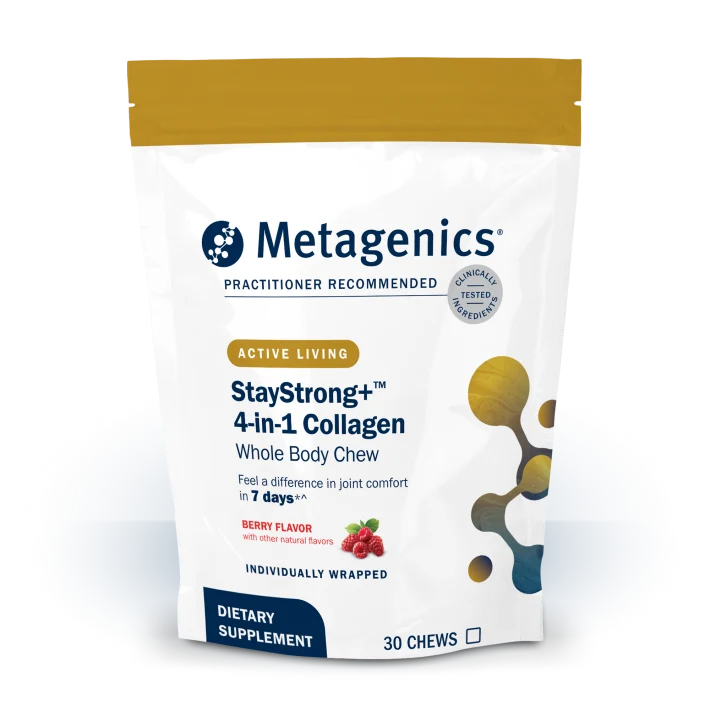
Four types of collagen in one chew, supporting joints, movement, and skin.*
StayStrong+ 4-in-1 Collagen Whole Body Chew
4.3Collagen, creatine, and magnesium powder for strength and joint health.*
StayStrong+ Joint and Muscle Powder
4.3Collagen + creatine powder for strength, energy, and cognitive support*
StayStrong+ Brain and Body Collagen and Creatine Powder
4.6